
If you follow marketing news at all, you have probably seen the headline: AI Overviews now answer most local searches. It’s the kind of claim that makes a busy therapist’s stomach drop. If Google is just answering everyone’s questions right at the top of the page, does that mean the people looking for a therapist never make it to your website?
It’s a fair worry. It is also, for therapy practices, mostly unfounded.
We did not want to guess, and we did not want to repeat someone else’s number. So we ran the searches ourselves.
We tested 96 of them across 12 cities, and looked at what Google really puts on the page. Here is what we found, and what it means for your practice.
Where That Scary Number Comes From
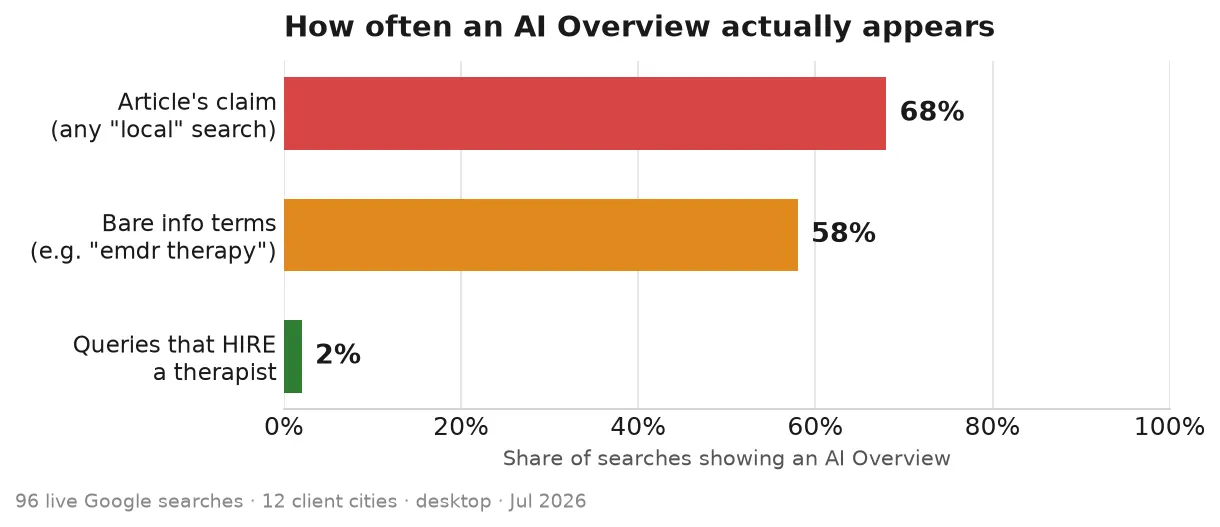
The headline rests on a single statistic: that AI Overviews show up for around 68% of “local” searches. The trouble is hiding in the word local.
(We’re not naming names in this article: we like to play nice. But it’s the kind of number that shows up all over the place.)
That number quietly folds together two completely different kinds of searches. There are informational questions that happen to mention a place, like “how long does an eye exam take near me.” And there are the searches someone types when they are ready to book a therapist: “therapist in Boulder,” “trauma therapist near me.”
When you count all the informational questions as “local searches,” you can make the AI Overview number look enormous. But an informational question is not the search that brings you a client. So we separated the two and tested them on their own.
So We Tested It: 96 Real Searches, 12 Cities
We ran live Google searches in 12 cities around the country, splitting them into the two groups that matter:
- Hire searches: what someone types to find and book a therapist (“therapist in [city],” “anxiety therapist [city],” “trauma therapist [city]”).
- Condition searches: broader terms people use to learn about a type of care (“emdr therapy,” “anxiety therapy,” “depression therapy”).
Then we simply counted: how often does an AI Overview actually appear, and what is inside it?
The Searches That Bring You Clients Almost Never Trigger an AI Overview
This is the part that should let you exhale.
When someone is ready to find a therapist, they search with intent, a service and a place. Across every one of those hire-style searches we ran, an AI Overview appeared just 2% of the time. Nearly always, what showed up instead was the local map pack and the regular search results, the same places that have always mattered for a local practice.
In other words, the search that fills your practice still works the way it always has. It’s won with a strong Google Business Profile, clear Specialty pages, and local relevance. AI has not stepped in front of it.
But What About Searches Like “Anxiety Therapy” or “EMDR Therapy”?
Here the picture is more interesting, and this is where a lot of the worry actually comes from.
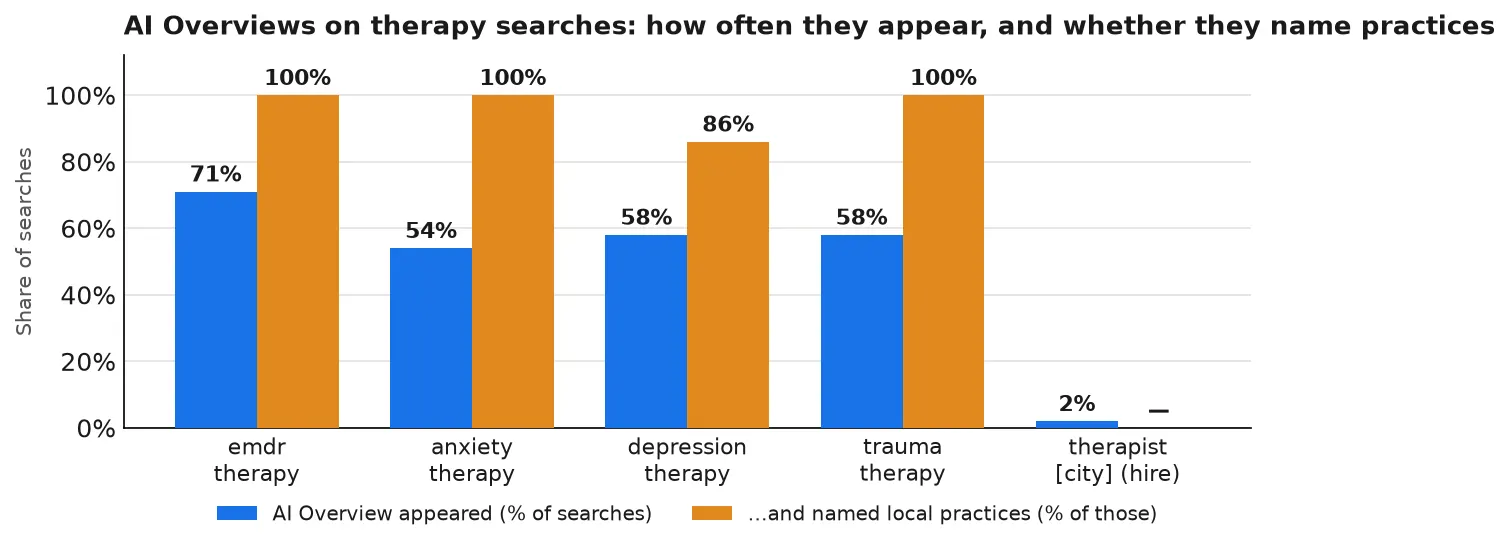
On these broader condition searches, an AI Overview shows up much more often, roughly 55 to 70% of the time. (It’s not consistent. Google rebuilds the overview on every single search, so the same term can show one on one visit and nothing on the next.)
And when the overview does appear, it usually does name local practices. So if you ever search one of these terms and seen a few practices listed inside the AI answer, you’re not hallucinating.
But Look at Where Those Practices Show Up
Being named in an overview and being featured in one are not the same thing.
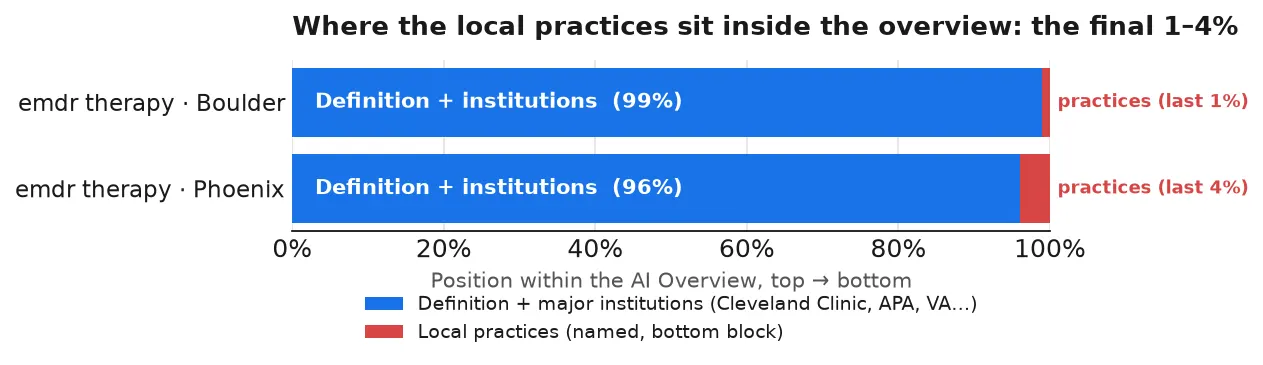
When we read these overviews closely, the local practices were almost always at the very bottom: the final 1 to 4% of the answer, tucked underneath a “Show more” button most people never click. The top of the overview, the part everyone actually reads, goes to the definition and the big institutions: the American Psychological Association, Cleveland Clinic, the VA.
Your practice, when it appears at all, is the footnote, not the headline.
What This Actually Means for Your Practice
Put it all together and the fear behind all those AI Overview-taking-over-local-search-headlines mostly dissolves:
- The searches that hire you have barely changed. They still go to the map pack and your website, and they are still won with the fundamentals.
- AI Overviews mostly appear on educational searches, the “what is this” questions, and even there they lead with the major institutions, not with practices.
- Getting named in an overview is a nice bonus, not a lifeline. And it tends to follow the same signals that already build local authority. You earn it by doing the basics well.
The point is not to ignore AI. It’s to keep a scary headline from pulling you away from the work that fills a practice.
A Quick, Honest Note on the Method
An AI Overview is not a fixed thing. Google rewrites it on every search, and it appears on some visits and not others. Our numbers are a snapshot from testing across 12 cities in 2026, not a permanent law of the universe. But the pattern held everywhere we looked: hire searches go to the map pack, and condition searches lead with institutions. We would rather show you tested numbers with that caveat than repeat a headline that sounds alarming and falls apart the moment you check it.
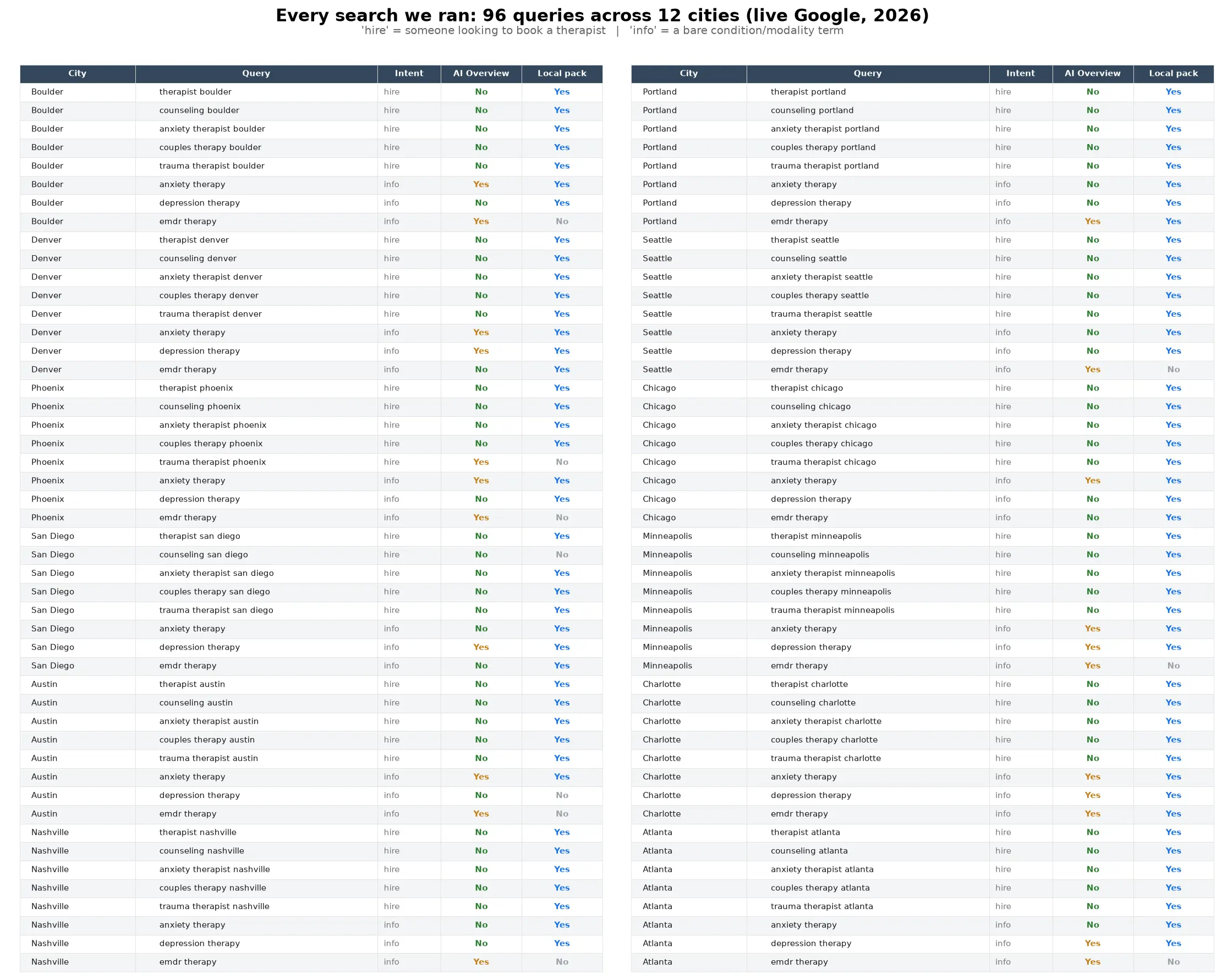
And here is every search we ran, so you can check the work yourself:
The Bottom Of The Overview
AI Overviews are real, and they are not going away. But they are not answering the searches that bring therapists clients, and where they do appear, your practice sits at the very bottom, well beneath the institutions.
For your practice, the game has not changed nearly as much as the headlines suggest. Show up clearly for the people searching for help in your area, keep your Google Business Profile and reviews strong, and write Specialty pages that speak to the client you want to reach. That is what fills a practice. Everything else is a distraction dressed up as an emergency.
