
“Do I need to start optimizing for ChatGPT?” We hear some version of that question every week. Vendors are selling AI visibility packages, and the pitch usually makes it sound like your website is about to be replaced by a chatbot.
So we went to the numbers. We pulled the analytics for the therapy practices we work with and looked at two things: how much traffic AI assistants send to a practice’s website, and how those visitors get there.
The short version: AI is still a small slice of how local clients find a practice. But when it does send someone local, about half the time it sends them through the practice’s Google Business Profile, and those visitors get in touch at about twice the rate of everyone else AI sends.
How Much Traffic Does AI Actually Send?
We looked at 28 practices from July through September 2026 and counted only local visitors (people in the practice’s own state) who found the site through a search engine or an AI assistant. We left out direct visits and paid ads, since neither tells you anything about being discovered.
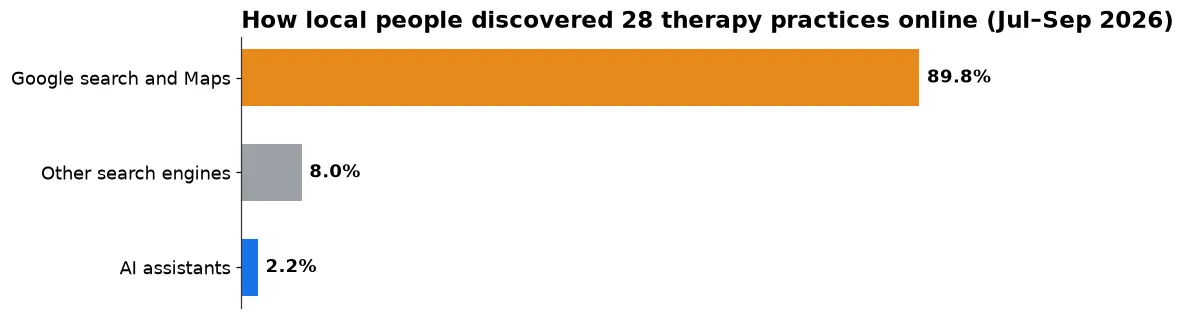
Google search and Maps brought in about 90% of those local visitors. AI assistants brought in 2.2%. That number is climbing (local AI visits across these 28 practices went from 176 in December to 242 in September), but it is not yet where most of your new clients come from.
Something Changed in December
In December 2025, ChatGPT started showing local business panels. Ask it for a therapist in your city, click a name, and a profile card opens with photos, ratings, business details and a website link. Near Media first documented these panels on December 22, 2025.
The website link in that card is the one from your Google Business Profile. We know because many of our clients’ profiles carry a small tracking tag on their website link, and since December that tag has been showing up on visits from ChatGPT. When it does, the person clicked through the profile rather than a link to the website itself.
About Half of Local AI Visitors Come Through Your Business Profile
Across 15 practices with a tagged profile link, AI assistants sent 860 local visits between December 2025 and September 2026. 388 of them, or 45%, came through the Google Business Profile. For ChatGPT alone, it was 53%.
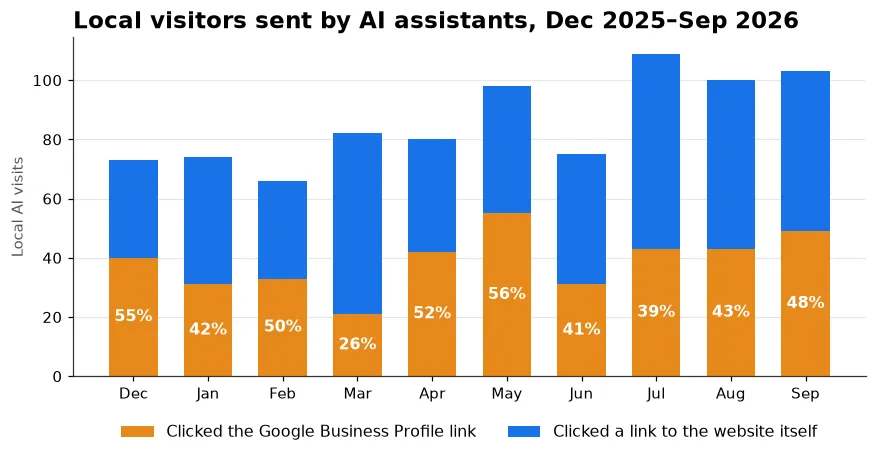
When someone asks ChatGPT for a therapist nearby, it is often showing them your Google Business Profile. The profile you already have is doing a lot of your “AI visibility” work.
And Those Visitors Reach Out Twice as Often
We counted inquiries the same way for every practice: contact form submissions, clicks on a booking link, and clicks on a phone number or email address. Then we compared AI visitors who came through the profile with AI visitors who came through a link to the site. This part uses the 12 practices whose profile links were tagged by December, so nothing gets mislabeled.
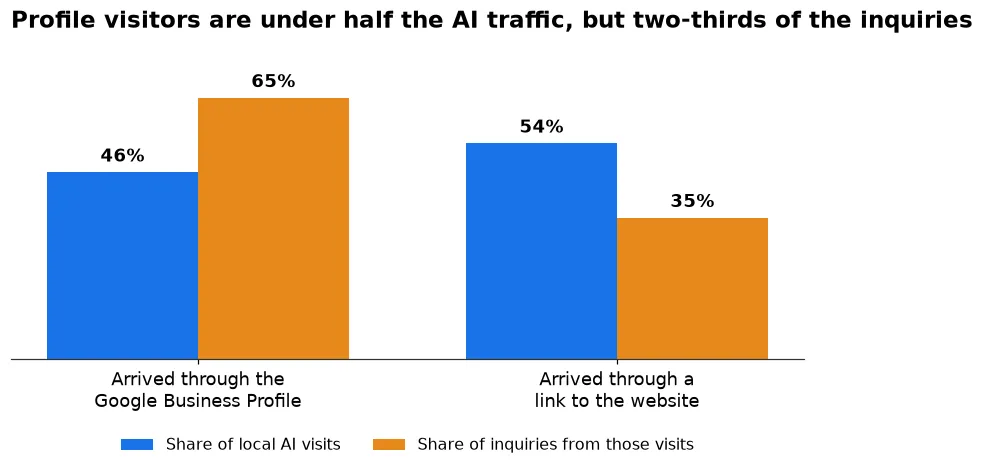
Profile visitors made up 46% of local AI visits and 65% of the inquiries. That works out to about 14.5 inquiries per 100 visits from the profile, against 6.8 per 100 from other AI links. Website-link visitors do contact practices too, just at about half the rate.
The likely reason is where each group lands. A profile click goes wherever your profile’s website link points, usually the homepage or a contact page, and the person arrives ready to act.
The Other Half: AI Is Reading Your Specialty Pages
When a local AI visitor doesn’t come through the profile, the link they click usually goes to a Specialty page. That’s ChatGPT citing your page in the written part of its answer.
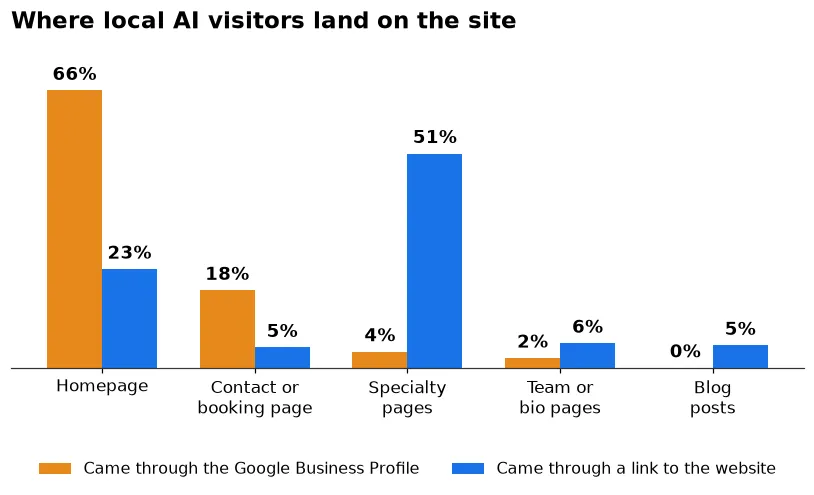
About half of those visitors landed on a Specialty page. Blog posts drew 5%. One practice’s IFS therapy page brought in 40 local AI visits on its own. When ChatGPT explains who can help with a specific concern, it quotes and links the page that answers that question best.
What This Means for Your Practice
Treat your Google Business Profile as your AI listing. Make sure your categories are right, your services match your Specialties, and your photos, hours and description are current. Point the website link at the page you’d want a new client to see first.
Make each Specialty page the best answer to the question it covers. Who you help, how you work with them, what a first session looks like, where you are, and how fees or insurance work. Plain, specific information is what gets quoted.
Add a tracking tag to your profile’s website link. It takes a minute in your Google Business Profile settings, and it lets your analytics show how many people reach your site through the profile, whether they found it on Google or in ChatGPT.
Be skeptical of AI visibility pitches that never mention your Business Profile. For local searches, it’s the first thing ChatGPT shows.
A Quick, Honest Note on the Method
This comes from the Google Analytics accounts of practices we work with. “Local” means visitors from the practice’s own state. AI traffic means visits referred by ChatGPT, Perplexity, Gemini, Claude and Copilot. The profile numbers start in December 2025, when ChatGPT’s local panels appeared, and cover only practices whose profile link carries a tracking tag. Everywhere else, profile clicks blend into general Google traffic.
This data has limits. Google Analytics undercounts AI traffic, because clicks from the ChatGPT app often show up as direct visits, so treat every AI number here as a floor. Inquiries are counted actions, and one person can fill out a form and click a phone number, so read them as rates rather than client counts. These are hundreds of visits, not millions; the direction is clear, but the exact percentages will move. And the December timing lines up with ChatGPT’s local panels, but we can’t see inside ChatGPT to confirm the cause.
The Bottom Line
AI isn’t replacing how clients find a therapist yet. Google still does most of that work. But for the local clients AI does send, the path often runs through your Google Business Profile, and the people who take it are the ones most likely to call. If you want to show up when someone asks ChatGPT for a therapist near them, start with the profile you already have. Then make sure your Specialty pages give ChatGPT something specific to quote.
